

Apply Superscript or Subscript in Microsoft Word (4 Ways)
by Avantix Learning Team | Updated March 21, 2026
Applies to: Microsoft® Word® 2016, 2019, 2021, 2024 and 365 (Windows)
You can apply superscript or subscript in Microsoft Word using keyboard shortcuts, buttons on the Ribbon or the Font dialog box. If you apply superscript, the selected letter, number or symbol will be raised slightly above the line of text and sized to a smaller size. If you apply subscript, the selection will be lowered slightly below the line of text and sized to a smaller size. It's common to use superscript or subscript for symbols such as trademark or copyright symbols, mathematical equations, chemical formulas, and footnote characters or numbers. Certain features in Word, such as footnotes, automatically create superscripted characters.
Contents
- Use a keyboard shortcut to apply superscript or subscript
- Use commands in the Ribbon to apply superscript or subscript
- Use the Font dialog box to apply superscript or subscript
- Remove superscript or subscript
- Insert a symbol
- Final thoughts
Recommended article: 3 Strikethrough Shortcuts in Microsoft Word
Do you want to learn more about Microsoft Word? Check out our virtual classroom or in-person classroom Word courses >
Use a keyboard shortcut to apply superscript or subscript
To apply superscript or subscript using a keyboard shortcut:
- Select the text character, number or symbol to which you want to apply superscript or subscript.
- To apply superscript, press Ctrl + Shift + equal sign (=). To apply subscript, press Ctrl + equal sign (=).
Note: We're using the equal sign at the top of the keyboard.
Use commands in the Ribbon to apply superscript or subscript
In Word, there are buttons in the Ribbon for superscript and subscript.
To apply superscript or subscript using commands in the Ribbon:
- Select the text character, number or symbol to which you want to apply superscript or subscript.
- Click the Home tab in the Ribbon.
- Click Superscript or Subscript in the Font group (X buttons).
Below are the commands in the Font group in Word (note the X buttons):

Use the Font dialog box to apply superscript or subscript
Since superscript and subscript are character formats that can be applied to text or a symbol, the most common way to apply them is to use the Font dialog box. You can select or deselect check boxes to apply or remove superscript or subscript.
To apply superscript or subscript:
- Select the text character, number or symbol to which you want to apply superscript or subscript.
- Click the Home tab in the Ribbon.
- Click the dialog box launcher on the bottom right of the Font group (corner button). Alternatively, press Ctrl + D. A dialog box appears.
- Select the Superscript or Subscript check box or press Alt + the underlined character.
- Click OK or press Enter.
Below is the Font dialog box in Microsoft Word:

Remove superscript or subscript
To remove superscript or subscript by clearing formatting:
- Select the text with the superscript or subscript formatting you want to remove.
- Press Ctrl + Spacebar. This will remove character formatting.
To remove or turn off superscript or subscript using a superscript or subscript keyboard shortcut:
- Select the text, number or symbol with superscript or subscript you want to remove.
- To remove superscript, press Ctrl + Shift + equal sign (=). To remove subscript, press Ctrl + equal sign (=).
To remove superscript or subscript using commands in the Ribbon:
- Select the text, number or symbol with superscript or subscript you want to remove.
- Click the Home tab in the Ribbon.
- Click Superscript or Subscript in the Font group.
To remove or turn off superscript or subscript using the Font dialog box:
- Select the text, number or symbol with superscript or subscript you want to remove.
- Click the Home tab in the Ribbon.
- Click the dialog box launcher on the bottom right of the Font group (corner button). Alternatively, press Ctrl + D. A dialog box appears.
- Select the Superscript or Subscript check box to deselect it.
- Click OK or press Enter.
Insert a symbol
If you insert specific symbols in Word, they are automatically superscripted. These include the registered trademark or trademark symbols.
To insert a symbol:
- Click where you want to insert the symbol.
- Click the Insert tab in the Ribbon.
- In the Symbols group, click Symbol. A drop-down menu appears.
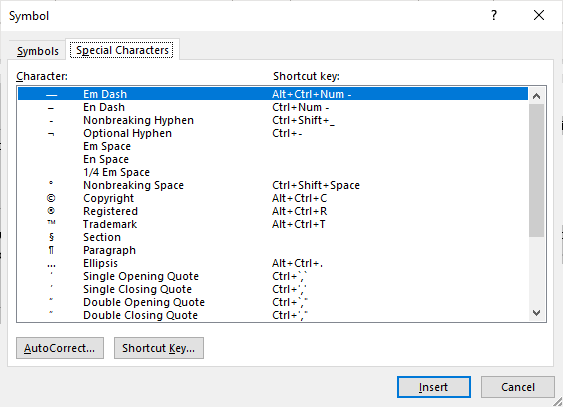
- Click More Symbols. A dialog box appears. In Word, there are two tabs at the top of the dialog box.
- Click the Special Characters tab.
- Click the special character you would like to insert such as registered trademark.
- Click Insert.
- Click Close.
The symbol will be inserted into the document.
The Insert Symbol dialog box appears as follows (with the Special Characters tab selected):
Final thoughts
Superscript and subscript can be used with many types of characters including those in mathematical equations.
This article was first published on September 9, 2020 and has been updated for clarity and content.
Subscribe to get more articles like this one
Did you find this article helpful? If you would like to receive new articles, JOIN our email list.
More resources
How to Create a Table of Contents in Word
How to Add Page Numbers in Word (Step by Step)
How to View Word Count in Microsoft Word (4 Ways)
How to Find and Replace in Word (and Use Wildcards)
How to Insert or Type the Degree Symbol in Word (5 Ways to Insert °)
Related courses
Microsoft Word: Intermediate / Advanced
Microsoft Excel: Intermediate / Advanced
Microsoft PowerPoint: Intermediate / Advanced
Microsoft Word: Long Documents Master Class
Microsoft Word: Styles, Templates and Tables of Contents
Microsoft Word: Designing Dynamic Word Documents Using Fields
Our instructor-led courses are delivered in virtual classroom format or at our downtown Toronto location at 18 King Street East, Suite 1400, Toronto, Ontario, Canada (some in-person classroom courses may also be delivered at an alternate downtown Toronto location). Contact us at info@avantixlearning.ca if you'd like to arrange custom instructor-led virtual classroom or onsite training on a date that's convenient for you.
Copyright 2025 Avantix® Learning
You may also like

How to Insert or Type an Upside Down Exclamation Mark in Word (5 Ways to Insert ¡ with Shortcuts)
This guide covers five easy ways to insert or type the upside down exclamation mark (¡) in Microsoft Word including shortcuts, Alt codes and custom key combinations. The upside down exclamation mark or inverted exclamation mark is used in the Spanish language at the beginning of exclamatory sentences and helps readers understand tone before completing the sentence.

How to Insert or Type I with an Accent Mark in Word (Í, í, Ì, ì, Î, î, Ï, or ï)
You can insert or type i with an accent mark in Word using built-in tools or keyboard shortcuts (including Alt code shortcuts). The letter i can be inserted with an accent in both upper or lower case. The following are common accented characters that you can insert or type in Word in upper or lower case: grave (Ì or ì), acute (Í or í), circumflex (Î or î) and umlaut (Ï or ï).

How to Insert or Type A with an Accent Mark in Word (À, Á, Â, Ä, à, á, â, or ä)
You can insert or type a with an accent mark in Word using built-in tools or keyboard shortcuts (including Alt code shortcuts). The letter a can be inserted with an accent in both upper or lower case. The following are common accented characters that you can insert or type in Word in upper or lower case: grave (À or à), acute (Á or á), circumflex (Â or â) and umlaut (Ä or ä).
Image credit(s) / application screenshot(s): Microsoft
Microsoft, the Microsoft logo, Microsoft Office and related Microsoft applications and logos are registered trademarks of Microsoft Corporation in Canada, US and other countries. All other trademarks are the property of the registered owners.
Avantix Learning |18 King Street East, Suite 1400, Toronto, Ontario, Canada M5C 1C4 | Contact us at info@avantixlearning.ca


